Learn to Meditate and Reach Your Personal Best.
Get Altitude with Meditation.NEW!
SydneyMeditationCoach.com
Meditation Classes & Courses Sydney | Learn to Meditate: 12 Different Meditation Techniques including Mindfulness & Primordial Sound
MEDITATION CLASSES AND COURSES SYDNEY | LEARN MEDITATION | LEARN HOW TO MEDITATE SYDNEY
NEW > ONLINE QUANTUM MANIFESTATION COURSE

Looking for a Meditation Gift Certificate? Click here
AWARDS:
You should follow me here:


 MEDITATION
… is a simple practice which can be practiced anywhere at anytime.
Meditation Techniques
… and Mindfulness are for calming mind and body – recapturing your personal power.
Meditating
… 15 to 20 minutes twice a day can relieve stress and anxiety. Meditation can raise the life of every individual to its full dignity in which perfect health, happiness and success are the NATURAL features of daily life.
The profound benefits of meditation are not so obvious to the beginner’s eye and through consistent coaching and diligently applying oneself change occurs.
Most people achieve a state of bliss, because that’s the state of mind which my students as well as myself reach after not only the first few meditations, but after many sessions of meditation as well. A feeling of mastery, ecstasy and well-being. After a deep meditation, I liken it to having taken a 6 week holiday, bursting with happiness and confidence.
Note: I offer a practical, powerful and rapid approach to accessing Alpha State, which is your most creative and relaxed state. Allowing you to feel calm, masterful and happy.
After all, isn’t what you’re looking for, is to change the way you feel? If bliss seems like a dream that is too far away from you – then now may be a good time to gently guide yourself back into your own personal power. MEDITATION is not a religion (although it has been incorporated into many religions), philosophy nor a lifestyle. There are so many different brands of meditation and whilst we can honour their traditions, I do not indulge you in endless psychobabble nor age-old mysteries which require you to reach cult status or master status in order to be practicing properly.
I offer a simple, practical scientific approach. It is a simple technique which, when practised regularly, restores inner calm, enabling you to unlock your full potential. This course such will offer you all that you need in order to meditate, as well as course notes supporting the links between quantum physics science, meditation and your divine self. We offer various techniques at your fingertips for restorative personal power. You will not need to go on an endless search for harmony and peace by doing various courses. It’s all right here!
Meditation is about many, many things…
It’s scientific; it’s spiritual without a religious leaning. It’s about release. It’s about decompressing. Releasing stress. Releasing everything which hampers from reaching our full potential. It’s about brainwaves. It’s about altering the electrical brainwave pattern from something that fries our brain to something which empowers us completely. Creativity, love, joy, happiness, healing and manifestation. (How much does illness cost the community; the world?)
Research into Meditation shows you have the ability to change. You have the power to change. Allow me to teach you! Which leads me right into the next point. Why meditate? What can it do for you? You can read all 100 meditation benefits here.
Meditation is a prelude to self-hypnosis. As I am also a hypnotherapist, I incorporate hypnotherapy into my meditation classes and courses to keep you meditating! This is an enormous help for those who have taken my course. After all, there is no point taking a meditation class if you don’t keep meditating!!!
Personal one-on-one or couples or small groups ENSURE that you get my individualised attention & reinforcement with my hypnotherapy to keep you meditating and reaping the rewards of meditation!
Further to this, I take you on an extended journey if you choose to do so. Remote Viewing, Remote Influencing, Hypnotherapy/Self-Hypnosis & NLP. Meditation is the basis for all of these modalities. I am the only coach I know of Australia-wide who offers further education in all of these areas combined.
So join me won’t you? Learn how to leverage the power of your mind and use healing & manifesting abilities known to shamans for centuries. Ok, so if you’ve seen The Secret and What The Bleep – and if you’re new to all of this, then you’re probably wondering how to piece it all together and manifest what you want! I invite you to explore the Sydney Meditation Coach website to Get Started Now!

What is Meditation?
Quite simply put, meditation is the ability to slow down the electrical frequency of your brainwaves through focussed breathing in order to be in a relaxed and creative powerful state.
However, many many things define meditation! It is also about finding the silence and the stillness in your being. Allowing your mind to just simply stand still. Something that many people in today’s modern world find a challenge. Rightly so. We are bombarded with more images and messages in the form of advertising, than ever before in the history of mankind. Releasing this daily stress is important so that your inner strength can rise naturally.
It is an experiential practice – meaning that it’s sometimes difficult for some who have not experienced it – to truly understand the profound benefits of being in a meditation. Daily relaxation and calming of the mind give you space, freedom, choices and better control over your life – in ways that perpetually stressed students find as bliss and happiness – a tremendous transformation of their lives.
Meditation of course also allows for more right brain thinking which is the creative, problem-solving part of our mind. It allows us access to the collective unconscious, which allows us to gather information intuitively and heal by ourselves. Problems dissolve and the lightness and happiness of being are more commonly observed in people who meditate regularly.
How I breathe is how I am. Dr. Richter of John Hopkins University, U.S.A., discovered that brain cells are capable of generating, storing and giving off electricity. In Beta state (the state associated with thinking, reasoning, analysis, worry, doubt, fear and logic), the brain cells fire off haphazardly. However, in Alpha state (our most creative state), the brain cells become synchronised and function TOGETHER. So when a person practises focussed breathing to access Alpha state they access a much greater level of power over the way they feel.
Once you have been practising for a while, the more focussed you will become. After you move from light meditations to deep meditations, you will be able to reach other very powerful states, through Delta and Theta states, which I also teach you about. For those who learn how to open the pathways or chakras in a balanced way, find that the endocrine glands heal the body and create natural highs. 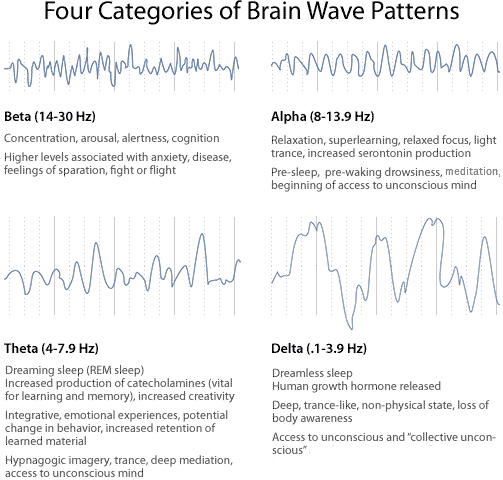
Beta Waves 14 Hertz (abbreviated hz, frequency measured in cycles per second) – 100 Hz These waves are the most powerful and dominant. This is the mental state the average individual generally functions in on a day to day basis. From focusing on daily issues to holding a conversation. Unfortunately for some of us, these brainwaves are in excess after teenage years and accelerate to after middle age; so it’s important to increase our relaxation as too much beta and not enough alpha, theta & delta cause us to feel the effects of stress.
Alpha Waves 8 Hz – 13 Hz A relaxed or passive state best achieved by closing your eyes and slowing down brain wave activity. Once you are in this state, alpha waves become dominant. In this state we become calm and begin to focus inward. The alpha state is extremely satisfying and nurturing. It is important to attain an alpha or neutral state at least once a day to reduce your unwanted stress level.
Theta Waves 4 Hz – 8 Hz Once we sink below alpha level waves, we reach theta. An elusive euphoric and mysterious state best associated with deep meditation. Many people find it hard to reach and maintain this level. With practice it also becomes easier to maintain without falling asleep. This state is much like being on the edge of sleep and wakefulness. In this state you may have many reveries (mental images) or thoughts pour forth. Much of our unconscious becomes revealed. This state is most conducive to hypnotic trance, placing mental suggestions, accelerating learning, facilitating healing and implementing peak performance techniques.
Delta Waves Below 4 Hz For most people, once we’re in this state we are either asleep or unconscious. In this level we produce large quantities of healing growth hormone which both strengthens and replenishes us. There is growing evidence which suggests that it is possible to attain this state and maintain consciousness. Well practised Zen Buddhist monk masters are said to be able to do just this, even while engaged in everyday affairs! With the help of the course and practise, it is possible for an individual to benefit from this state and learn to attain it in significantly less time than an accomplished Zen monk.
Other practices which enable you to reach Alpha State: Other various “brands” of meditation, various forms of yoga, tai chi, qi gong, prayer and chanting and mantras.
- Meditation is also the first stage of Self-Hypnosis.
Other ways of inducing alpha state:
- Listening to music in 4/4 time (examples):
- Air (Johann Sebastian Bach) Canon: (Johann Pachabel)
- Rolling your eyes upwards into the back of your head.
- Having your feet elevated higher than your head or legs on the wall (90 degrees) or on an elevated pillow etc.
Studies with brain wave frequency have shown that smelling frankincense or lavender increases alpha waves, which are of course, associated with relaxation and intuition. (*Frankincense has been swung around and wafted down church aisles for years) However, deep breathing meditation still remains the most powerful access key.
Frequently Asked Questions:
What doctrine do you follow? -After having studied many forms of meditation to reach alpha,theta and delta states, this is a culmination of all of my studies.
Is this a religious group? – No, definitely not. We are not a religious group and as such encourage you to keep your own faith if you practice one.
If it’s simple, why does it take 6 or more sessions? -It’s quite normal, especially while under stress, for your conscious and subconscious to fight with each other. The conscious mind acts as a guard dog to the subconscious. Therefore it takes a retraining of the mind for your conscious mind to accept it. We offer an experiential course in which it is easy for you to find that pathway. Habits take time to form. You’ll gain one that is a wonderful habit!
What will it feel like? What will I experience? -Initially,you may feel like you have had a 6 week holiday in half an hour. Some may feel overwhelmed with the release of so much stress. Some may feel like nothing happened. Don’t worry. All of this is normal. The most important thing you can do is to keep meditating. You will notice the differences in the way you react, feel in synchronicity with life and experience peace and happiness, or in other words, The Bliss that comes from being in a relaxed state.

Benefits of Meditation:
Are you continually stressed, overwhelmed by life’s pressures? Are you feeling so stressed that you’re disconnected from your loved ones and your environment? Isolated? Experiencing events without feelings? Experiencing automatism (not noticing what you do)? Never feeling like you have had enough rest? Are you just trying to cope? Or simply looking to become all that you can be? Then join us for some rest, some peace and quiet and immediate empowerment. The effects and health benefits of meditation are both immediate and cumulative. Can you imagine how creative and how much fun your family, friends and co-workers would become if you practised together? Get together and spur each other on! We encourage it!
Benefits of Meditation:
Meditation activates the Parasympathetic Nervous System. The sympathetic and parasympathetic work in OPPOSITION, when one is turned on, the other is turned off.
Sympathetic Nervous System (SNS): “Stress” – key neurotransmitters are epinephrine and norepinephrine and the hormones are cortisol, insulin and grehlin; increasing alertness, fight-flight-freeze-feint response, mobilised energy, increased heart rate, elevation in muscle tone (to get away), diminished blood flow to organs that aren’t vital eg brain, gut, liver…
Parasympathetic Nervous System (PNS): “Relaxation” – key neurotransmitter is acetylcholine and the hormones are oxytocin, growth hormone and testosterone; rest and digest (digestion and peristalsis optimised), optimal organ function (including the ALL important LIVER), tend and befriend, creating energy reserves, calmness, reduced heart rate, decreased alertness…
Meditators secrete more of the hormone of health & youth, DHEA as they age than non-meditators. Meditating forty-five-year-old males have an average of 23 percent more DHEA than non-meditators, and meditating females have an average of 47 percent more. This helps decrease stress, heighten memory, preserve sexual function, and control weight.
Benefits of Meditation (short list)
The effects of more DHEA (Dehydroepiandrosterone) include: *Anti-aging, longevity *Enhanced mood, energy and memory *Improved immune system *Boosted sex drive *Reduced osteoporosis *Improved fat loss *More muscle mass *Reduced autoimmune disorders *Less heart disease
- The calming hormones melatonin (which research suggests, boosts the immune system and has anti-cancer effects; it also happens to help with anti-aging) and serotonin (the hormone which makes you happy), are increased by meditation, and the stress hormone cortisol is decreased.
- Meditation creates a unique hypometabolic state, in which the metabolism is in an even deeper state of rest than during sleep. During sleep, oxygen consumption drops by 8 percent, but during meditation, it drops by 10 to 20 percent.
- Meditation is the only activity that reduces blood lactate, a marker of stress and anxiety.
- Meditation has a profound effect upon three key indicators of aging: hearing ability, blood pressure, and vision of close objects.
- Long-term meditators experience 80 percent less heart disease and 50 percent less cancer than non-meditators.
- 75 percent of insomniacs were able to sleep normally when they meditated.
- 34 percent of people with chronic pain significantly reduced medication when they began meditating.
- Results show that: 24 cities in which 1% of the population had been instructed in meditation by 1972 displayed decreased crime rates during the next year and decreased crime trends during the subsequent five years (1972-1977) in comparison to the previous five years (1967-1972), in contrast to control cities matched for geographic region, population, college population, and crime rate. Journal of Crime and Justice, 4:25-45, 1981. Except for the last item these statistics are found in Meditation as Medicine by Dharma Singh Khalsa, 2001.
Increased intuition and psychic abilities – remote viewing and remote influencing. For more information click here. The definitive (long) list of the benefits of meditation is here. A Harvard University study published in 2008 found the first compelling evidence that the Relaxation Response (RR) – the physiological response to meditation, yoga, tai chi, Qi Gong or repetitive prayer – positively affects DNA. Nineteen adults were long-term daily practitioners of various RR techniques, 20 were trained in RR eliciting techniques (breathing, mantra and mindfulness meditation) for 8 weeks, and 19 served as controls.
By analysis of blood samples, the study found that 2209 genes were differently expressed (switched on or off) between the long-term meditators and control group. Specifically, 1275 were up-regulated (their activity was increased) and 934 were down-regulated (their activity was reduced). It also found that 1561 genes were expressed differently between the group who did the 8 weeks meditation training and the control group. Specifically, 874 were up-regulated and 687 were down-regulated. In other words, meditation – short or long term – causes hundreds of genes to turn on or off.
Many of the genes were involved in cellular metabolism and in the body’s response to ‘oxidative stress’. Oxidative stress is one of the biological products of mental and emotional stress. It produces free radicals and is known to be involved in a host of disease processes, including atherosclerosis, Parkinson’s disease and Alzheimer’s disease. It also accelerates aging at the cellular level. Ideally, we want a good response to oxidative stress so that we can prevent the negative effects.
In the study, blood analysis found significant changes in cellular metabolism and response to oxidative stress in the two meditation groups relative to the control group. The scientists proposed that the Relaxation Response – whether it is induced through meditation, yoga or prayer – may counteract cellular damage due to chronic psychological stress.
People have meditated for years and enjoyed better health (and a slower aging process) but many others have been sceptical as to its benefits. Now, we have solid scientific proof of the positive genetic effects of meditation in that it affects genes that positively influence cell metabolism and the response to oxidative stress. Here’s the link to the article. http://www.plosone.org/article/info%3Adoi%2F10.1371%2Fjournal.pone.0002576 You can download the PDF free: This article is Copyright © 2008 by David R. Hamilton Ph.D.
The Importance of Continuing Meditation:
It is important to stress that meditation is a training process in which the recipient takes an active role and engages in regular meditation in classes AND at home in order to develop a skill, much like learning to play a musical instrument.
Sometimes under heavy stress, it is sometimes difficult for the mind to stand silent and for this reason I offer longer meditation courses with more classes. Without proper training and support, it can take a long time for people who have been under enormous stress to actually do it. People have spoken to me about having bought tens of books and doing courses, only to find that they feel their money has been wasted because they cannot “get back into it”, because they’re too busy, or at least their mind is and they need some structure to help them through. We would hope that you make a commitment to the empowerment yourself by continuing to meditate. Dealing with daily stress is exhausting. Meditation gives you the opportunity to put yourself in a state of total resourcefulness, which, needless to say, is extremely empowering.
Regular Meditation
It’s important to remember that the effects of meditation are both immediate and cumulative! So if you meditated every day last week and only twice this week, you will notice that even though you had a break for a few days, will definitely feel different each time but your meditation benefits will slowly grow stronger over time. I also give you the key to motivating yourself to practice meditation regularly when under heavy stress.
I took up meditation to calm & relax my mind. To lower my stress and anxiety levels. It has helped me learn how to control my stress and anxiety levels through meditation. It has also taught me the power of positive thinking and that I have the ability to manifest anything I desire. Thank you for all of your help Trish! March 8th 2015
Trish is an extremely dedicated coach. She has taught me techniques which have helped me to transform my life. I now feel able to face any challenge through creating my world from my mind. Very powerful techniques.
I have never felt more in tune with myself or my surroundings than when doing the meditation sessions with Trish. I felt healthier and happy and had more energy than I have ever had! Aug 21, 2012
Challenging for me, but very rewarding. This is one of the most powerful meditation techniques I’ve learnt. It was difficult for me to release at first, very difficult. But I had overcome that by the 3rd session and have had much happiness come into my life. Thank you for your patience with me.
Hello Trish, How are you? I’m very good and I see results coming out of meditation, hence I just wanted to drop you a note to say thank you. After 3 months I got a very good pay rise and the promotion…all of which were among my intentions when I started. Other stuff that I noticed: sometimes it stops raining, I don’t have to wait at the cross stripes (amazing how cars are just far enough to let me cross in time), nobody gets in my way when I’m in a crowded area. I just need to meditate more but these days are kind of crazy… the initial results are stunning.
Hi Trish. I’m a new mum and was very tired. I’ve got more energy now and my baby is calmer too, as you said she would be. and me too! Thanks again!
Meditation Classes, Courses & Fees ... read more

Meditation Classes & Courses Available Via Skype
- Personal One-to-One Instruction (& via Skype for those unable to attend physically)
- Couples Instruction
- Small Group Instruction (no more than 3)
- Family or larger Group Instruction (please contact me for details with the number in the family if more than 3)
I offer a practical, powerful and rapid approach, which gets immediate results. Although we focus upon this method which most students do find to be the most effective, you have the option to explore 12 different ways to meditate. Classes are 90 minute sessions and include hypnotherapy sessions to help you to keep meditating! (Only for those booked for 6 classes or more.)
I find that this reinforces the value to clients and they receive greater benefit. If you are within 20 mins drive of the Sydney CBD, then meditation classes can be in the comfort of your own home or office. Naturally, your home or office must offer peace and quiet with absolutely no disturbances. If this is not the case, then you will need to come to one of my offices – either in the Sydney CBD or Woollahra . As my office is shared, I will supply the address upon the confirmation of an appointment to avoid people turning up when the office is unattended.
There is a fee structure for individuals, couples and small groups of three persons as follows below. Please note that each session should be no more than a week apart. This gives time for the new meditator to develop his or her skills. At home practice is an essential part of the course.
Each student is expected to practice his or her meditation twice daily for at least 20-30mins, six days per week in between classes.
You can pay by Paypal or credit card – by clicking on the payment you wish to make below. (no Paypal account required). Please email or telephone me with questions or preferred course start dates for your course.
If you require bank (EFT) details, please allow for this in an email and I will confirm with you and send bank details. *Payment for a single class or a course is required before or on the day of your course commencement
More About your Meditation Coach, Trish ...
Sydney Meditation Coach …
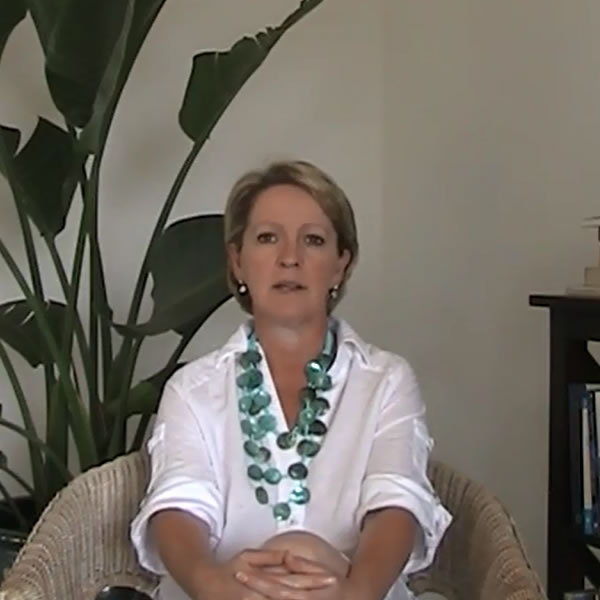
Trish (above), has been practising meditation in Sydney for 15 years and over that time has taught many family and friends. Eight years ago I was teaching meditation in Sydney with my previous website – and became too busy with life to continue teaching and I have now brought myself back to what I know best. I am able to provide students in Sydney with intelligent, harmonious and intuitive meditation teaching and with a keen insight into people can help individuals with their specific needs. Especially people with high level stress.
Sydney Meditation Coach: Why have a coach? The reason for having a coach is simple – it’s much like having your own personal trainer! Having studied various forms of Psychology (Jung/Adler/Freud), Meditation, Alpha Rhythm Dynamics, Yoga, Tai Chi, Self-Hypnosis (I am also a Clinical Hypnotherapist), NLP Practitioner & Master NLP Practitioner; more recently, Reiki Seichim Telepathic Healing, Remote Viewing and Remote Influencing and a keen interest in the mechanics of quantum physics – my teaching is a culmination of my many studies and experiences, all of which I continue in an effort to expand my experience and knowledge. I also enjoy sailing, walking my dog, tennis, squash, swimming, horseriding, travelling, trading the foreign exchange markets, and I spend time daily remote viewing and influencing (theta and delta states).
My remote viewing and remote influencing studies are with Gerald O’Donnell’s Academy of Remote Viewing and Remote Influencing (ARVARI) for nearly five years now. I have achieved a 75-80% accuracy when remote viewing. Imagine the results! As a child I was naturally clairvoyant and others did not understand my abilities nor my natural ease of high positive energy. But this was only an intermittent ability due to many factors. Highly sensitive and perceptive, I saw many future events and was in a state of Zen for a lot of my early childhood. Early in life everything was easy for me – until family events changed life. Meditation has been a natural pathway back to Zen (or bliss). In high school, I was so much in Theta and Delta naturally, one of my teachers, (much to his permanent discredit) thought I was drug effected.. …LOL! In the 70’s and 80’s I was lured by Omni Magazine which offered exploration into future science and beyond. I saw the very first lotto numbers (I was one number short of the big one!), winning horse race numbers and many other future visions. I also used holosynch sound and other light technology in the 80’s to alter brainwave frequencies.
Fascinated as to WHY people die, (I (probably) naïvely thought they never should – and probably knew intuitively that the mind does not). I wanted to become a coroner and did a week’s work experience in the morgue and pathology). My favourite movie is Contact (with Jodie Foster). The original book was the 1998 Hugo Prize winning book written by the late Carl Sagan (astronomer and astrochemist). I also studied acting (Stanislavski method) with the late Brian Syron at City Acting Studios in William Street, Sydney for three years. (Syron also taught at the Stella Adler Studios in New York & L.A.). My voice training was with Gina Pioro and Cicily Berry. I also appeared in a few commercials, television shows and theatre productions – one which made the Guinness book of records at the time.
Sydney Meditation …
My life’s path has been permanently on track, even with life’s ups and downs, to connect with the One Universal Mind- Deep Delta – Which is all that heals and all that creates and all that loves. With meditation, courage to face everything comes from the knowing that being connected to the One (Universal Mind), you can achieve, accomplish and conquer anything, be it a goal or negative entity.
Sydney Meditation Coach:
“I hope that people recognise the importance of taking the time to practise something so simple to empower themselves.” It’s an intelligent choice. Naturally. If bliss seems like a dream that is too far away for you – then now may be a good time to gently guide yourself back into your own personal power.
My main goal when teaching meditation is to get you into the habit of meditating regularly to generate benefits for yourself. I will teach you how to motivate yourself and you won’t be able to stop the bliss! 🙂
There is only one question I will ask you before commencing the course and it is the KEY: Are you willing to make the commitment to empower yourself? When you choose to do so, the following will happen: The trust and surrender to your (higher) self – combined with focus and intent will make your mind very, very powerful. Your life will become effortless… really. I offer Sydney Meditation Classes and Sydney Meditation Courses for groups and individuals. Contact Sydney Meditation Coach … today!
How many sessions do I need?
If you are a self starter and have self discipline then 6 lessons may be a good place to start.
Meditation Coaching isn’t instant therapy. It’s a service designed to help relatively self-sufficient people dissolves stress, improve sleep, achieve more success and many many more benefits. (Hypnotherapy or NeuroFeedback or counselling may be an alternative for other obstacles.)
Do you think that you can build a muscle by going to the gym once per week if you’re extremely unfit? Of course not 😉 When people want to get fit, they spend hours and hours at the gym & thousands of dollars on personal trainers & gym memberships. If you have a high degree of stress, and really want to feel lighter, experience more happiness and change your life, I suggest 8-10 sessions to begin with and here then is what I require from you. Commitment.
What this means is that you must be coach-able, participate honestly and be able to follow instructions and participate in meditation daily outside of your lessons. It means that you are accountable for your own progress and success. It means that you need to put your heart into the course and participate earnestly. Even with the best coaching at your disposal, only you can create actual change.
With Coaching you get Results.
BONUS FOR A LIMITED TIME ONLY!
ALL PACKAGES $1999 AND OVER RECEIVE A COMPLIMENTARY 4 Days/3 Nights GETAWAY WITHIN AUSTRALIA.
INTERNATIONAL OPTIONS AVAILABLE FOR STUDENTS OUTSIDE OF AUSTRALIA.
(TERMS & CONDITIONS APPLY. AIRFARES NOT INCLUDED.)
... 100% BLISS ... 10 Sessions
from ...... ENJOY MORE ... 8 sessions
from ...6 Classes Basic
from ...Don't leave empty handed! Your FREE Meditation & Ebook... Secrets to Meditation
Enter your name and email address below …